- All
- Product Name
- Product Keyword
- Product Model
- Product Summary
- Product Description
- Multi Field Search


| Quantity: | |
|---|---|


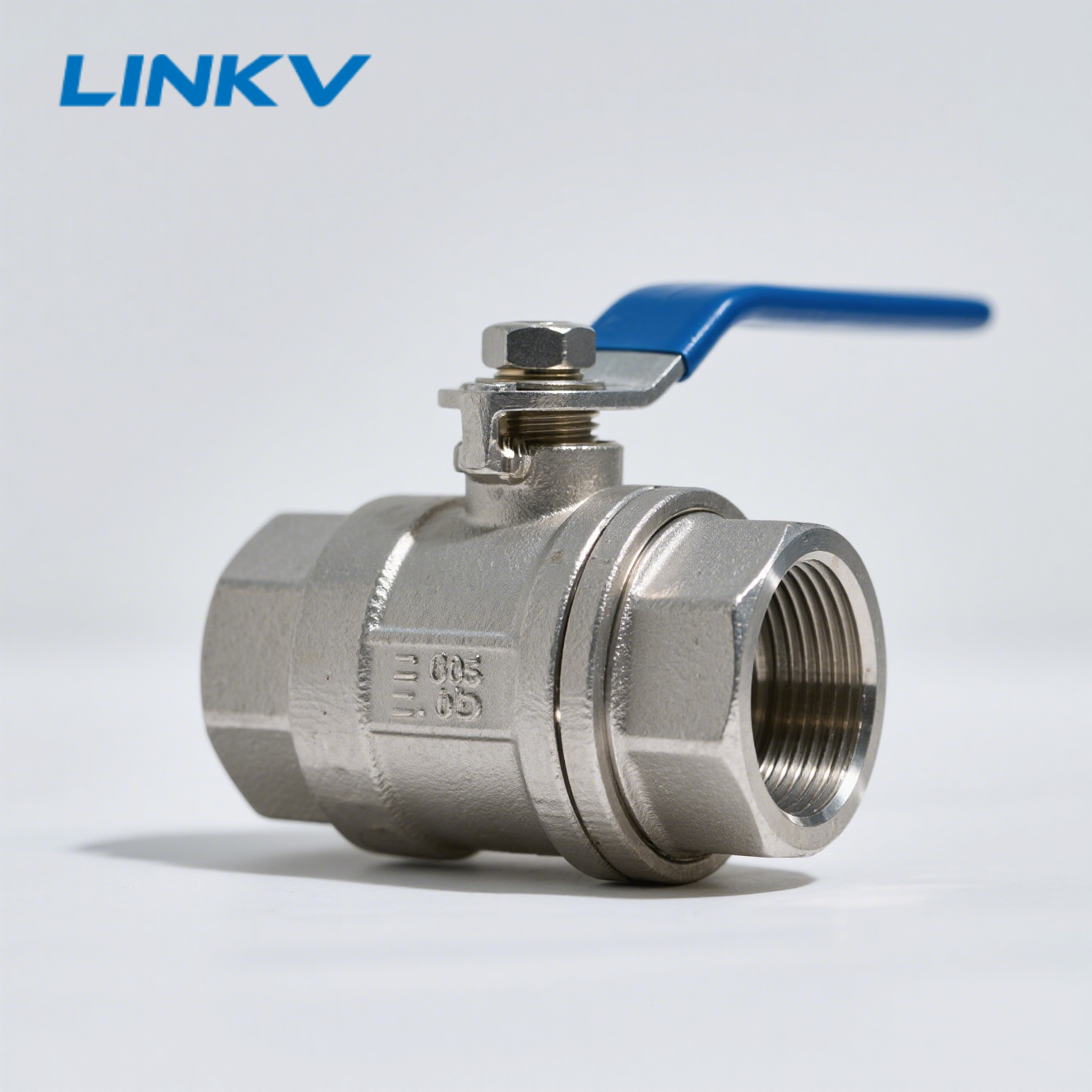
The LINKV two-piece threaded ball valve is manufactured in line with GB, ANSI, JIS, DIN, BS and ISO standards. It adopts a two-piece body structure that supports on-site maintenance without full removal from pipelines. Available in full bore and reduced bore configurations, the valve features stainless steel construction and optional polymer seats. It serves flow control and shut-off needs in petroleum, chemical, natural gas, water treatment and shipbuilding sectors for commercial procurement.
This valve holds API607 7th edition certification. In fire scenarios, the secondary metal-to-metal seat structure provides bi-directional sealing capability. The design has passed 30-minute fire exposure followed by high-pressure testing, with no visible leakage under standard-specified test conditions.
The valve uses a live-loaded stem packing design, which has passed TA-LUFT and ISO15848-1 B1 tests. The methane leakage rate is ≤ 50 ppmv, meeting environmental regulations for volatile organic compound and hazardous fluid handling. This design fits chemical and natural gas transmission scenarios with emission control requirements.
All valve bodies are produced via investment casting. Material composition is verified by OBLF spectrometers with 0.001% detection accuracy, and machined on CNC centers with tolerance ≤ ±0.01mm. Each valve body has a unique heat number, enabling full material traceability for over 10 years. Materials comply with REACH, RoHS and EU-1935/2004 regulations.
ISO 15848-1 cycle tests show the valve completes over 20,000 open-close cycles without leakage. It also holds TÜV-issued SIL3 certification per IEC 61508, with Probability of Failure on Demand (PFDavg) ≤ 1.0×10⁻⁴, suitable for safety instrumented systems in industrial applications.
Every valve unit undergoes three mandatory full-coverage tests: 100% hydrostatic shell test at 1.5× rated pressure, 100% high-pressure pneumatic seat test at 1.1× rated pressure, and 100% Positive Material Identification (PMI). Each unit comes with a signed test report.
The valve offers NPT, BSPT, BSPP and PT thread options, with pressure ratings from Class 150 to Class 1500 (PN10 - PN160). Standard PTFE seats support temperatures from -20°C to +250°C; specialized sealing materials are available for service up to +450°C or cryogenic conditions down to -196°C.
Size Range | DN6 – DN100 (1/4" – 4") |
|---|---|
Pressure Rating | Class 150 – Class 1500 (PN10 – PN160) |
Temperature Range | -196°C to +250°C (standard PTFE); up to +450°C (optional) |
Body Material | Stainless Steel CF8 (304), CF8M (316), CF3M (316L), 304L, 316L |
Ball Material | Stainless Steel (same as body), mirror-polished |
Seat / Seal Material | PTFE, RPTFE, PEEK (optional) |
Stem Packing | Live-loaded PTFE / Graphite (TA-LUFT certified) |
End Threads | NPT, BSPT, BSPP, PT |
Fire Safety | API607 (7th edition) |
Fugitive Emission | ISO15848-1 B1 (methane ≤ 50 ppmv) |
Functional Safety | SIL3 (TÜV, IEC 61508) |
Testing | 100% Hydrostatic shell (1.5× rating); 100% Pneumatic seat (1.1× rating); 100% PMI |
FAQ
This two-piece ball valve supports flow control and shut-off functions across industrial applications including petroleum processing, chemical production, natural gas transmission, water treatment systems and shipbuilding, for media such as liquid, gas and steam within specified pressure and temperature ranges.
Standard body materials include CF8 (304 stainless steel), CF8M (316 stainless steel), CF3M (316L stainless steel), 304L and 316L. Balls use the same material grade as the valve body with a mirror-polished surface. Custom material configurations are available for special working conditions.
Every unit completes three mandatory tests: hydrostatic shell testing at 1.5 times the rated pressure, pneumatic seat testing at 1.1 times the rated pressure, and positive material identification for composition verification. All tests follow industry standard protocols with traceable records.
Yes. Besides standard PTFE and reinforced PTFE seats, PEEK and other high-performance sealing materials are optional for elevated temperature service up to 450°C. Specialized cryogenic sealing configurations can also be provided for applications down to -196°C.


